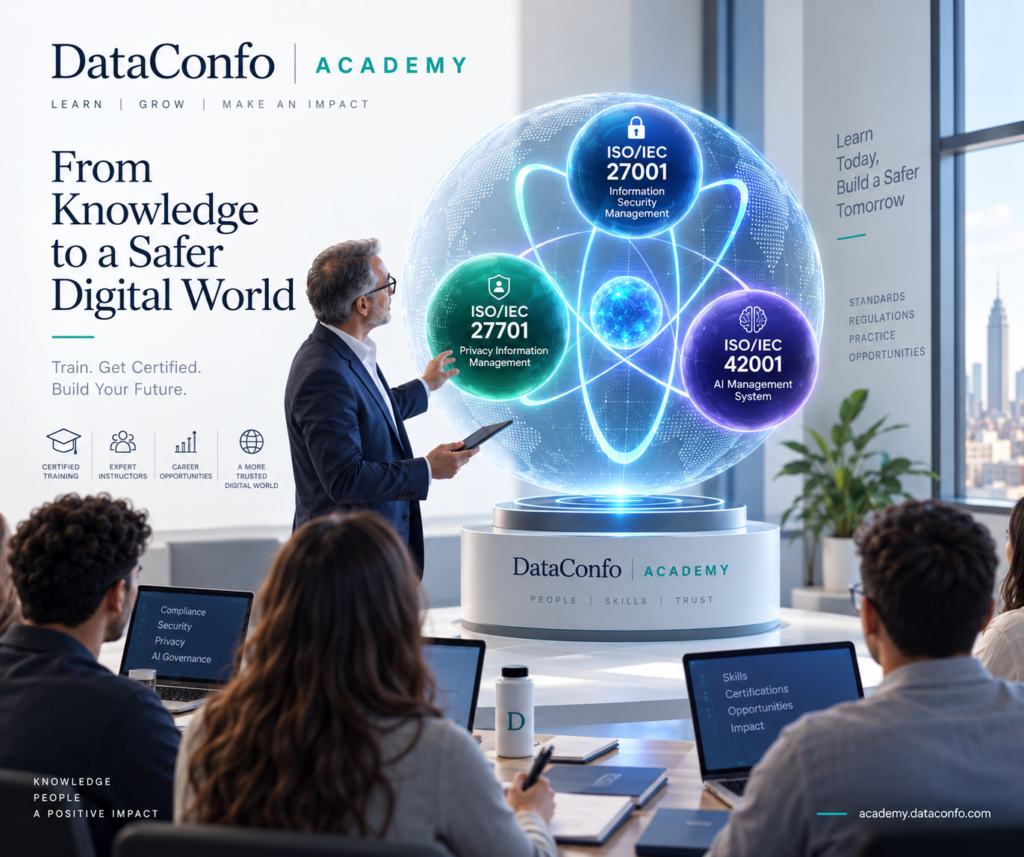
Digital transformation creates new opportunities for businesses, but it also increases their exposure to cybersecurity threats, personal data risks and the governance challenges associated with artificial intelligence.
In this context, three international standards are becoming increasingly important: ISO/IEC 27001, ISO/IEC 27701 and ISO/IEC 42001.
They address three complementary areas:
ISO/IEC 27001 → Information security
ISO/IEC 27701 → Privacy and personal data management
ISO/IEC 42001 → Artificial intelligence management and governance
These three standards do not officially constitute a single “trio” or integrated framework. However, they can be viewed as three complementary pillars of digital governance for organizations.
1. What is the purpose of an ISO management system?
A management system standard provides organizations with a structured framework to define objectives, identify risks, establish responsibilities, implement controls, measure performance and continuously improve their practices.
The objective is therefore not simply to create procedures or obtain a certificate.
The real value of a management system lies in its ability to integrate a strategic issue into the organization’s day-to-day operations.
This is particularly important for information security, privacy and artificial intelligence, where risks and regulatory expectations are constantly evolving.
2. ISO/IEC 27001: Managing Information Security
ISO/IEC 27001 defines the requirements for an Information Security Management System (ISMS).
It provides organizations with a systematic approach to identifying, assessing and treating information security risks.
Information security is not limited to IT infrastructure.
It also involves people, processes, policies, access management, suppliers, business continuity and all the information that is critical to the organization.
What does ISO/IEC 27001 bring to a business?
Implementing an ISMS can help organizations:
- identify and manage information security risks;
- protect the confidentiality, integrity and availability of information;
- strengthen organizational resilience;
- clarify security responsibilities;
- meet the requirements of customers and business partners;
- strengthen credibility in demanding markets.
ISO/IEC 27001 certification can also provide organizations with an additional way to demonstrate their commitment to information security to customers, partners and other stakeholders.
For businesses, information security therefore becomes more than a technical function. It becomes a governance, trust and competitiveness issue.
Training in ISO/IEC 27001
DataConfo Academy provides training designed to help professionals understand the requirements and implementation principles of an Information Security Management System.
Explore ISO/IEC 27001 Foundation training : Lead Implementer, Lead Auditor.
3. ISO/IEC 27701: Structuring Privacy Management
Organizations do not only need to protect their information. They also need to demonstrate that they properly manage the personal data they collect and process.
ISO/IEC 27701 provides a framework for establishing, implementing, maintaining and continually improving a Privacy Information Management System (PIMS).
It is particularly relevant for organizations acting as personal data controllers or processors.
Why is ISO/IEC 27701 important?
Organizations process personal data every day:
customers, employees, prospects, suppliers, candidates, visitors, website users and many others.
The question is therefore no longer simply:
“Do we have a privacy policy?”
The more important question is:
“Can we demonstrate that we effectively manage our personal data processing activities?”
A Privacy Information Management System helps organizations structure privacy governance, clarify responsibilities, improve processes and establish appropriate evidence of compliance.
ISO/IEC 27701 and regulation
An ISO standard and a law are not the same thing.
Regulation establishes legal obligations. A management system provides a structured framework to organize governance and demonstrate how those obligations are addressed.
ISO/IEC 27701 can therefore support an organization’s privacy compliance strategy, but it does not replace applicable legislation.
For organizations operating in Morocco, this distinction is particularly important when considering the relationship between international standards and the Moroccan personal data protection framework, including Law No. 09-08 and the CNDP.
Training in ISO/IEC 27701
DataConfo Academy provides training for professionals who want to develop their expertise in privacy management, personal data governance and the implementation of ISO/IEC 27701.
Explore ISO/IEC 27701 Foundation training : Lead Implementer , Lead Auditor
4. ISO/IEC 42001: Governing Artificial Intelligence
Artificial intelligence offers major opportunities for productivity and innovation, but it also introduces new categories of risk.
Data used by AI systems, transparency, bias, accountability, security, appropriate use, monitoring and regulatory compliance are increasingly becoming governance issues.
ISO/IEC 42001 is the international standard for an Artificial Intelligence Management System (AIMS).
It provides organizations with a structured framework to establish, implement, maintain and continually improve their AI management system.
Why is ISO/IEC 42001 strategic?
For a business, the question is no longer simply:
“Are we using artificial intelligence?”
It is increasingly:
“Do we know who is using AI, for what purpose, with which data, under which responsibilities and with what risks?”
AI governance provides a structured approach to answering these questions.
It can help organizations improve transparency, accountability, traceability and risk management while supporting more responsible and controlled adoption of AI.
Training in ISO/IEC 42001
DataConfo Academy provides training designed to help professionals understand AI management systems and the governance challenges associated with artificial intelligence.
Explore ISO/IEC 42001 Foundation training : Lead Implementer , Lead Auditor
5. Three Standards, Three Challenges, One Digital Governance Approach
These three standards can be viewed as complementary:
ISO/IEC 27001
Protect information.
ISO/IEC 27701
Govern personal data and privacy.
ISO/IEC 42001
Govern artificial intelligence.
An organization using AI systems processes information.
That information may include personal data.
It therefore also needs to address information security risks.
This is why these three areas are becoming increasingly interconnected.
6. What Is the Business Value?
Investing in these areas should not be viewed solely as a compliance cost.
For organizations, the objective is to turn governance into business value.
Security
Better risk management can reduce exposure to security incidents and their potential operational consequences.
Credibility
Being able to demonstrate structured governance and risk management can strengthen trust among customers, partners and business stakeholders.
Market Access
In certain industries and supply chains, security, privacy and AI governance requirements are increasingly becoming part of supplier and partner selection criteria.
Cost Reduction
Better-defined processes can reduce duplication, clarify responsibilities and improve operational efficiency.
Controlled Innovation
A strong governance framework allows organizations to adopt new digital technologies and AI while integrating risks into the decision-making process.
The real ROI of a management system should therefore not be measured only by the cost of certification.
It should also consider:
costs avoided + efficiency gains + risks reduced + business opportunities created.
7. Why Invest in Training?
Organizations cannot build sustainable governance systems by relying exclusively on external consultants.
They also need internal expertise.
Training employees helps organizations develop internal capabilities, improve ownership of management systems and progressively reduce their dependence on external resources.
Training can therefore become an investment in both human capital and organizational resilience.
For companies, developing internal skills can contribute to reducing implementation and maintenance costs over time.
For professionals, training can provide the knowledge required to enter or strengthen their position in a growing field.
8. Professional Opportunities in Security, Privacy and AI Governance
For professionals, these areas represent an expanding field of expertise.
Knowledge of ISO/IEC 27001, ISO/IEC 27701 and ISO/IEC 42001 can support different career paths:
Employment — information security, compliance, risk management, privacy, auditing and AI governance.
Consulting — helping organizations design and implement management systems.
Freelancing — gap assessments, governance projects, documentation, internal audits and implementation support.
Training — developing and delivering professional training programs.
However, knowing a standard is not enough.
The real value of a professional lies in the ability to translate requirements into practical organizational solutions and connect international standards with applicable regulatory requirements.
This is particularly valuable for professionals working at the intersection of business, law, compliance, risk and technology.
9. DataConfo: Connecting Regulation, Standards and Implementation
At DataConfo, we help organizations connect three essential dimensions:
Regulation → Standards → Implementation
Our consulting practice supports organizations in regulatory compliance, governance and the implementation of management systems related to information security, privacy and artificial intelligence.
We can also support organizations in the development of an Integrated Management System (IMS) bringing together, where appropriate:
ISO/IEC 27001 → Information Security
ISO/IEC 27701 → Privacy Management
ISO/IEC 42001 → AI Management
An integrated approach can help organizations:
- avoid duplication between policies, procedures and controls;
- align roles and responsibilities;
- integrate risk management processes;
- establish a common governance structure;
- improve operational efficiency;
- facilitate monitoring, auditing and continual improvement.
Rather than developing three completely separate systems, an organization can design an integrated governance architecture where common processes are shared while the specific requirements of each standard remain properly addressed.
DataConfo can support organizations with:
- current-state assessment;
- gap analysis;
- management system architecture;
- policies and documentation;
- implementation support;
- awareness and training;
- regulatory alignment;
- preparation for audits.
The objective is not to build documentation for the sake of documentation.
It is to develop a management system that is proportionate to the organization’s risks, objectives and operational reality.
10. DataConfo Academy: Building the Skills Behind Digital Governance
DataConfo Academy provides professional training covering information security, privacy, cybersecurity, AI governance and management systems.
Our objective is twofold.
For organizations: develop internal capabilities, reduce reliance on external resources, improve ownership of management systems and support regulatory compliance.
For professionals: develop skills that can be leveraged in employment, consulting, auditing, compliance and freelancing.
Professionals who want to specialize in the regulatory, governance and management dimensions of these standards can also contact DataConfo to identify the training path best suited to their career objectives.
11. Cybersecurity and the Moroccan Regulatory Framework
Digital governance cannot be separated from the applicable regulatory environment.
In Morocco, Law No. 05-20 on cybersecurity establishes a national framework for cybersecurity and applies specific requirements to different categories of entities and operators.
The General Directorate for Information Systems Security (DGSSI) plays a central role in Morocco’s national cybersecurity framework.
For Moroccan organizations, it is therefore relevant to consider both applicable regulatory requirements and international management standards such as ISO/IEC 27001.
Conclusion
ISO/IEC 27001, ISO/IEC 27701 and ISO/IEC 42001 address three major challenges facing today’s digital organizations:
protecting information, managing personal data and governing artificial intelligence.
For organizations, these standards can contribute to stronger security, credibility, customer trust, market access and operational efficiency.
For professionals, they represent valuable skills that can support careers in employment, consulting, auditing, compliance and freelancing.
But the real value does not lie in certification alone.
It lies in the ability to translate standards and regulations into management systems that actually work within the organization.
This is the approach of DataConfo:
supporting organizations with implementation, regulatory compliance, governance and, where appropriate, the development of an Integrated Management System combining ISO/IEC 27001, ISO/IEC 27701 and ISO/IEC 42001;
and training professionals who want to develop the skills needed for the emerging digital trust economy.